

Second and third Working Holiday visa rules will change from 1 March 2027, although the government has softened the plan it put forward in September. If you only read one part of this guide, make it the next two paragraphs.
Already in Australia on a Working Holiday visa? You can stay on the current rules by finishing your specified work and lodging a valid second (or third) visa application no later than 28 February 2027. Anyone applying for a second or third Working Holiday Maker visa on or after 1 March 2027 must first hold the new “Next Year Regional Work Guarantee”, and a second visa will then need 4 months of specified work instead of 3. Nothing changes for the third visa, which still needs 6 months.
Industry pushed back hard, and the third-year cap has gone from the proposed 5,000 to 25,000. The second-year cap is 45,000, as set out in the Minister for Home Affairs’ release “A fairer and more sustainable Working Holiday Maker program” (17 November 2026).
How is the final package different from the September proposal?
Second visa places stay at 45,000, third visa places rise from 5,000 to 25,000, the second visa work requirement grows to 4 months, and the new system begins on 1 March 2027.
Minister Tony Burke first floated a ballot for second and third-year Working Holiday visas in his National Press Club speech on 17 September. Farmers, tourism operators and hospitality businesses objected strongly, and when the revised package arrived two months later it was labelled a “backflip” (Source: ABC News, 17 November 2026).
| Item | 17 September proposal | 17 November final package |
| Second visa places | 45,000 | 45,000 (2026–27) |
| Third visa places | 5,000 | 25,000 (2026–27) |
| Second visa specified work | 88 days (unchanged) | 4 months (from 1 March 2027) |
| Third visa specified work | 6 months | 6 months (unchanged) |
| Start date | Originally scheduled for November | 1 March 2027 |
| UK citizens | Exempt | Exempt |
One detail in the Minister’s release is easy to miss: days you work before 1 March 2027 are not wasted. They carry over and count towards the longer 4-month requirement.
How many applicants will miss out under the new caps?
If this year looks like last year, about 1 in 5 people who do all their regional work could still miss out.
Last year, roughly 57,000 people qualified for a second visa and roughly 31,000 for a third. Set against those numbers, the new caps would cover about 79% of second visa applicants and 81% of third visa applicants. The gap is what leaves around one in five people without a place.
Compared with the 5,000 proposals, that is a big improvement. Even so, I would no longer tell anyone that 88 days of farm work makes a second visa a sure thing.
How will the Next Year Regional Work Guarantee work?
It works in two steps: register your interest online, then wait for an invitation, which is what lets you lodge the visa application.
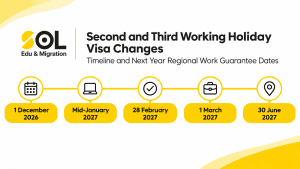
Key dates from the Minister’s release:
| Step | Date or rule |
| Registration portal opens | 1 December 2026 |
| First monthly invitation round | Expected mid-January 2027 |
| Registrations valid until | 30 June 2027 |
| Invitation valid for | 12 months (lodge your visa application within this time) |
| Guarantee required for | Second and third visa applicants from 1 March 2027 |
| Exempt | UK citizens |
The only group left out is UK citizens, who stopped needing regional work under the Australia–UK Free Trade Agreement (Source: ABC News, 17 November 2026). Everyone else on a subclass 417 or 462 visa is covered, whether they come from Korea, Japan, Taiwan, France, Germany or any other partner country.
What has not been announced yet?
Several practical details are still missing, starting with how invitations will be given out. The question clients ask us most is whether it will be a lottery or first come, first served, and right now nobody outside government knows. The release does not say:
- Who gets an invitation in each monthly round, and on what basis (media reports have called it a ballot) (Source: ABC News, 17 November 2026)
- Whether registration is only open to people who have already finished their specified work (the September plan required this before entering the ballot) (Source: InDaily, 17 September 2026)
- Whether subclass 417 and 462 applicants share one pool of places or get separate allocations
- Whether there is a cost to register, or any extra age or nationality conditions
The Department of Home Affairs is expected to fill in these gaps around the time the portal opens on 1 December. We will update this guide once it does.
What does this mean in a real case?
Anyone who was planning to start regional work in March 2027 now faces the Guarantee and a 4-month requirement, unless they can finish earlier and lodge by 28 February. We have had a run of enquiries like this one in the past week:
| Detail | Situation |
| Nationality | Korea (subclass 417) |
| First WHM arrival | August 2026, Brisbane |
| Current situation | Working at a café in the city, no regional work started yet |
| Original plan | 88 days on a Bundaberg farm starting March 2027 |
| Result | Lodging after 1 March 2027 means the Guarantee is required, plus 4 months of specified work |
| Alternative | Go regional over December–January, finish the 3 months, and lodge the second visa before February ends to keep the current rules |
The deadline catches people out because it has two parts. By 28 February you need to have finished the work and also lodged a valid application. Finish on 25 February, wait on a late payslip, lodge in early March, and the new rules apply. Leave yourself at least two weeks of breathing room.
And if 3 months before March isn’t realistic, don’t give up on the days you’ve already done. They count towards the 4-month total, so it still makes sense to keep working.
What should current Working Holiday Makers check now?
Check your dates against 28 February, have a registration plan ready for 1 December, and keep your longer-term plans flexible.
- Check your dates. Count back from 28 February and see whether you can finish your specified work and lodge in time. If you can, that is the safest route.
- Plan to register if you can’t. The portal opens on 1 December. The rules for registering haven’t been published, so read the official notice first. Registrations lapse on 30 June 2027, which doesn’t leave much time, so work out your timing early.
- Expect more change. The Opposition, led by Angus Taylor, has promised to scrap the changes if it wins office. The National Farmers’ Federation supports the package in principle but is holding back full support until it sees how the system will run in practice (Source: ABC News, 17 November 2026). Don’t build a long-term plan that depends on today’s rules staying put.
Is the second visa still worth working towards?
Yes, but finishing the work no longer guarantees the visa, so have a back-up plan.
For two months, clients kept asking whether regional work was worth it if the second visa might not come through, and there was no straight answer to give. Now there is more to go on. The jump to 25,000 third-year places and the window until 28 February are real wins for working holiday makers. What has changed for good is that the work alone no longer secures the visa. If a student visa guide or another visa is part of your longer plan, work out your next steps now rather than later.
FAQ
Q1. I already hold a second visa. Do I need the Guarantee for a third visa?
Only if you lodge on or after 1 March 2027. The work requirement for a third visa is still 6 months. Finish those 6 months and lodge by 28 February, and you can apply the existing way.
Q2. I’ll finish my work before 28 February but lodge in March. What happens?
You would fall under the new rules. The existing process is only available if the work is finished and a valid application is lodged by 28 February. Gather your documents while you’re still working so you can lodge in February.
Q3. I did 2 months of work before March. Do I lose that time?
No. Those 2 months count towards the new 4-month total, leaving 2 months to go. Because your application would be lodged after 1 March, you would also need the Guarantee.
Q4. My UK friend says she doesn’t need to do regional work. Does that apply to me?
No. The exemption is only for UK citizens, under the Australia–UK Free Trade Agreement. Applicants from Korea and every other partner country still need regional work and, from 1 March 2027, the Guarantee.
Q5. Can I register for the Guarantee right now?
Not yet. Registrations open on 1 December 2026, with the first invitations expected in mid-January 2027. How people will be selected, and the full requirements, are still to be announced.
Get advice on your next visa
Want help working out your dates or your next visa? Contact SOL Edu and Migration and one of our registered migration agents will get back to you shortly.
Related reading
Written by Namho Kim, Registered Migration Agent (MARN 1683521)
The visa information in this article reflects publicly available sources as at 17 November 2026. Rules change often, so please check the latest information before you apply.